Tuesday, May 3, 2011

Black Canyon Rim

Joshua and Oscar standing above the Black Canyon.
Pink pegmatite intrusions :)
Black Canyon.


A view of the San Juans.

April 30, 2011

During the middle of night, we burrowed deeper into our sleeping bags. Outside, the wind buffeted the sides of the tent.

By the time the sun rose, we were ready to go. Nothing like freezing temperatures to get your ass in gear. All of our water bottles were frozen shut. Oscar's nose was cold, but the jacket seemed to do the trick.

In the car, we followed the reservoir West. At Sapinero, we turned North onto 92 heading towards Crawford. For nearly 50 miles, we hugged the rim of the Black Canyon on Gunnison. Ranches with thousands of acres abutted the road, and silvery birch trees passed the window like an old, stuttering film reel.

In the fields and on the rim, large mule deer with white, tufted haunches graze on grass frosted with dew. Below them, the canyon dips low and out of sight. We pull into an overlook and peer at the green, rushing water of the Gunnison River.

Eventually, the road turns away from the canyon rim, and we drive out into a beautiful, green valley. To the East, the West Elk Mountains are covered in snow, but here, the Crawford Reservoir is sparkling in the sun. Unlike the scrub and sage near the Blue Mesa, this valley looks like rich farm land, and horses and cows graze in the pastures. It's story-book beautiful.

Just outside of Crawford, we turn South, headed for the Black Canyon of the Gunnison National Park. Behind us, the sky is blue, but in front of us, low, grey clouds color the canyon, well, black. We're beginning to discover a few things about our new state, and one of them is, the weather can turn on a dime, from mile to mile and minute to minute.

At the rim of the canyon, we pay the park entrance fee and apologize to Oscar. He has to stay in the car while we hike the North Vista Trail. He curls up in the back seat and lays his nose between his two front paws. He sighs. He falls asleep.

From the trail head to the lookout point is three and a half miles. We run most of the way, pausing to take pictures of gorge and admire the view. The trail is lined in Pinyon and Juniper, and the canyon is stripped with pink intrusions of pegmatite. The walls are dripped with black stains from Iron and Magnesium mixing with bacteria. It's beautiful and strange, and once again, we're all alone on the trail. There weren't even any cars in the parking lot.

At the lookout, we take photos of the panorama, but it's cold, and we don't stay long. We run back down, feeling the thin air burn in our lungs. We're at 8,000 feet.

Back at the car, Oscar greets us with sloppy kisses. We joke that Oscar's affection is better described as "tongue" rather than "kiss." Joshua starts singing the Talking Heads. "Give me sugar on my tongue," he says, as he ruffles Oscar's ear, and Oscar slobbers over his nose and cheek.

For lunch, we drive up along the rim and stop to walk the short, informative trail. Using the pamphlet, we pause to read about each place marker. Unafraid to go meta, the National Park authors explain just how the canyon should make us feel small, big, inconsequential, and yet, deeply meaningful. We groan with each paradox and file away useful pieces of information like pegmatite, magnesium/bacteria stains, and the life cycle of a juniper tree.

From the Black Canyon, we head back on 92 towards Delta and then take 50 going South towards Montrose. I can't keep my eyes open, and I fall asleep as Joshua drives.

In Montrose, we decide that Lesson 16 of Pimsleur will get the blood flowing, and as we drive out into the dry, scrubby plains, we practice Spanish.

The scenery changes again, and now we're driving into the San Juan Mountains. Just as we hit our first set of switchbacks, we pass through the cute, tourist mountain town of Ouray. A sign announces that this town considers itself 'America's Switzerland.'

550 crosses several passes and cruises through the old mining town of Silverton. We drive through, heading the signs that tell us to 'Keep Moving, Avalanche Danger.' Joshua is a bit white knuckled, but mostly, we're in awe of the landscape. I was here once before in my Sophomore year of high school, but that was in the middle of summer. Spring here looks a lot more like the thick of winter. The hills are covered in thick, pillowy blankets of snow.

The drive to Durango takes us a couple of hours, but the scenery is gorgeous, and the conversation is easy (as usual :)). The sun breaks through as we drive into the Durango valley, and we point at homes, saying, 'I could live there.' Joshua laughs when I point at mobile homes, but I'm only half-way kidding. Who cares if you live in a double wide if you get to wake up to THIS?

In Durango, we turn onto Junction Creek Road. Up in the hills, we past geodesic domes and adobe homes with solar panels. A couple of homes are barn/home hybrids. We think this might be where the hippies live :)

Luckily, Junction Creek Campground opened yesterday, and we're one of the first to arrive. We get our pick of the campsites, and the fee is half price. Joshua and I set up the tent, and then we play Frisbee. Oscar runs back and forth between us, but when we try to get him to fetch, he looks at us with disappointment. "I'm far to dignified to fetch," he sneers and plunks down to chew on his paws.

For dinner, we make pasta. We eat it wearing mittens (no small feat) and predict another cold night. When the sun sets, we dress up Oscar in my rain jacket, don every last layer, and burrow into our sleeping bags.

Cold Blue Mesa

Oscar in my rain-jacket.

Elk Creek Campground at Blue Mesa. It felt about as cold as it looks

Hawk (or Falcon? I'm a little hazy on my birds of prey) outside of Gunnison.

April 29, 2011

I wake up and look over at Joshua. His sleeping bag is cinched so tightly, I can't see skin. I nudge him and ask him if he was cold during the night. He mumbles in the affirmative.

Seeing that we're awake, Oscar hops up onto our cots and snuggles in between us, shivering. We press our cold noses against one another.

We break camp, and less than an hour later, we're back on the road. Before us, the road follows the Arkansas River, and above us, the sky is encoded with various predictions. Rain, snow, clouds that touch the earth and obscure the horizon. Even blue sky.

In Poncha Springs, we take 50 headed West. The road climbs steadily over Monarch Pass, and at the top, the peaks are covered in a powdery blanket of snow. Chairlifts that have retired for the season sway lonesome in the wind.

On the other side of the pass, the western slope unfolds. Colorado may be famous for its Rocky Spine, but it has a grand set of ribs: the West Elk Mountains, Sawatch Range, and San Juan Mountains are visible from this place, high on the Continental Divide. From here, all rivers flow West.

In Gunnison, we turn North on 135 and then West on Ohio Creek Road. At Mill Creek, we take to the dirt road, and at the trail head, we picnic in the car, dipping hard boiled eggs in mustard and red hot chili powder.

Strapping on our snowshoes, we climb into the West Elk Wilderness on the Mill-Castle Trail. High in the mountains, we see spires of rock reaching upward. Snowflakes drift down lazily. The sky is grey.

We snowshoe for hours. The snow is deep, and the trees afford us shelter from the wind. There is no one here. High in the mountains, abandoned log cabins sit stranded in deep snow. There are no traversable roads to get here. We wonder who owns them and when they stay there. Are these summer homes? Imagine owning a four-story log cabin summer home!

Up the trail, we stumble upon a piece of Rubbermaid Tupperware stuffed in the stump of a tree. We pull it out and discover a Geo-cache. People have left small, inconsequential things: a bandanna, an empty bottle of sunscreen, coins, a whistle. We flip through the journal, write down a few words, and leave Joshua's Ellsworth library card. We take a skeleton doubloon.

It starts to snow harder, and we turn around. It's all down hill on the way back, and Oscar races on ahead, jumping and pirouetting in the snow.

Back at the car, we again peel off our sopping socks. As we're driving back down the road, we spy an enormous hawk, perched on a fence post. We drive up close, and it stays still and allows us to take a photo.

We drive back through Gunnison, and snow turns to rain. We continue West of 50, headed toward the Blue Mesa Reservoir, Colorado's largest body of water. As we leave the snowy peaks behind us, the land from side to side is clothed in Sage. Up on the hills, Pinyon and Juniper twist their gnarled, stubborn limbs against the wind. We've read that juniper can cut off supply to a limb, should it need to. The limb will fall off and die, giving the tree the extra reserves it needs to live on.

At Elk Creek Campground, we turn toward the water. It starts to rain harder.

Sitting above the water, completely exposed to wind and rain, we decide to sit in the car for a while and let the weather change its mind. I pull out my book, and by the last page, it's stopped raining. We set up camp, and Joshua stakes everything in with the back of his hatchet. He assures me that we're not going to blow away. I look at the ominous sky and our lack of windbreak and nod my head, noncommittally.

Once our tent is staked to the ground, we walk through the sage to the rocky beach. We're wearing our down jackets, and our hands are shoved in the pockets, our collars up near our ears. Blue Mesa is a fitting name. With all the flat-topped hills around, the reservoir looks like another inverted, blue table.

For dinner, we heat up a can of re-fried beans and eat them with the corn bread Joshua made before we left. There's no running water nearby and the thought of touching the reservoir's freezing water makes us shudder. Oscar obligingly cleans our dishes.

As the sun begins to set, we pack into the tent. I dress Oscar in my rain jacket so he won't be cold, and we laugh at his fumbling tries to walk. In the end though, he curls up and falls asleep. We stick our hands down the collar of the jacket, and inside, his fur is warm.

We play a couple more games of boggle, and afterward, I start my next book, Plainsong. But just as the last 100 pages of a good book hold me captive, the first hundred are less enticing. I fall asleep with the book tented upon my chest.

Buena Vista, Happy Birthday

Not sure how to place photos in text and in chronological order :)

Joshua leaning against our car between Buena Vista and Cottonwood Pass.

Sign outside of Buena Vista.

Tumbleweed :)

Drive-thru theater.

Road up to Cottonwood Pass. It got snowier as we went along, and we were glad to have our snowshoes.

Oscar and his grin :)

A view of South Park.

On Thursday morning, April 28, we loaded our little red Hyundai, turned the key in the ignition, and drove towards the mountains.

Three blocks down, we turned around and retrieved my library book, Plainsong, by Kent Haruf.

Once again, we hopped in the car, rolled the windows down, fired up some tunes, and then turned around - this time to retrieve extra blankets, just in case.

The third time we pulled away from the curb outside of our new home, I looked at the clock. It’s 9:30 AM, and I’m 25 years old. Scrolling through texts on my phone, I see happy birthday wishes from family and friends, and I think how bizarre it is to have been alive for a quarter of a century, a generation, two and a half decades. I feel old and young at the same time. My father-in-law, Tim, reminds me that I’m celebrating this birthday in the same state where I was born, and I pause to admire the symmetry.

My husband prides himself as a ‘notch-on-the-belt kind of guy.’ As we turn onto 285 heading out of the city, he catalogues my notches.

“You’ve gotten a degree, you’ve completed two years of teaching, gotten married, traveled for four months in South America, one month in Greece, and six months in Europe and India and Nepal. You have a cat and dog and a new job. You’ve lived in Minnesota, Washington, Louisiana, Wisconsin, and Colorado… Twice. I’d say you’ve cleaned up!”

I assess my resume from Joshua’s perspective, and I agree that it’s been an eventful 25 years, but at the same time, I’ve had moments when I have stopped to think about how quickly time moves and how scary it is that a moment lived is just as soon gone. I know that I’m far too young to talk about mortality with any real wisdom, but my two years in New Orleans showed me a certain fragility. Sometimes I’m afraid I won’t be able to fit everything in, and I’m terrified of wasting time. I sit in the doctor’s office, and I’ll think, “huh, I guess I’ll never be a doctor.” And although I’ve never particularly wanted to be a doctor, it makes me just a little bit sad.

But before I get too melancholy, Joshua asks me, “if you could choose a super power, what would it be?”

I think for a moment. Maybe I’d be like the fairies in Fern Gully and make things grow. Or maybe I would be a healer. That would be cool. But when I think about all the super-power TV shows, books, and movies, it strikes me that none of the heroes or villains got to choose their super-powers.

“I don’t know,” I say, “it seems like the better question would be: if you were born with a super power, what would it probably be?”

Joshua pauses for a moment. “Huh,” he says. In the silence that follows, we contemplate the immense profundity of my observation.

“I know what super power you would have,” I say.

Joshua would have the super power to intuit topography and blueprints before arrival. Although not a part of his super power, he would develop a talent for drawing topographic maps and blueprints over the years, and his skill as a strategist and memory for directions (abilities that he was born with but are not super powers - unless you consider the ability to remember 10 to 15 step directions a super power, which I guess is debatable) would make him a valuable asset in crime, war, and adventure. His weakness is an inability to sense biological matter in either landscapes or buildings before arrival, and he must be within 200 miles of the landscape or building to sense its unique topographic or blueprint layout.

Once I’ve told him, Joshua expresses initial disappointment that telekinesis passed him by, but ultimately, he agrees. “It just makes sense,” he says.

Ironically, Joshua decides that I would have the super power of healing. By touching others and concentrating, I was first able to heal basic scrapes and burns, and as I grew older and stronger, I became able to heal larger injuries. My weakness is that healing others drains me, and it takes time - sometimes even weeks - to recover from healing. That’s why I have to work out like “a chick being chased by a hamburger.” I have to keep up my strength.

As we drive, I keep a steady playlist of Adele, Mumford and Sons, Joni Mitchell, and Brandi Carlile coming through the speakers. I play all of my favorite songs (in no particular order):

I Miss You by Blink 182

Brick by Ben Folds Five

Paper Planes by MIA

Maps by Yeah Yeah Yeahs

Dreams by The Cranberries

High and Dry by Radiohead

Hide and Seek by Imogene Heap

De Perros Amores by Control Machete

Beautiful World by Colin Hay

Dixon’s Girl by Dessa

Skinny Love and Blood Bank by Bon Iver

Lay Lady Lay by Bob Dylan

Anthems for a 17 Year Old Girl by Broken Social Scene

Yellow by Coldplay

Heavenly Day by Patty Griffin

Seven Nation Army by The White Stripes

Eyes by Rogue Wave

Half Acre by Hem

Orange Sky by Alexi Murdoch

Pink Moon by Nick Drake

The Freshman by The Verve Pipe

Re-Offender by Travis

Kids by MGMT

Can’t Stop by The Red Hot Chili Peppers

Push by Matchbox 20

Desperately Wanting by Better than Ezra

Joshua has heard this same playlist over and over, but since it’s my birthday, he applauds each choice and sings along.

The road winds through passes and bends, and we steadily climb higher. Smooth hills covered in brush make way for steeper hills covered in evergreens. Two hours into our drive, we pull over to look out over South Park, a wide high-alpine plain surrounded by gorgeous snow-capped mountains, blue skies and white, pillowy clouds.

We get out to stretch our legs, and we look so good doing it, three more cars pull in to do the same. One couple is from Baton Rouge, and when we reveal that we lived and taught for two years in New Orleans, they look at us as though they think we might be lying. We tell them that our cat’s name is Thibodeaux, and they smile easily. We aren’t lying after all. The man looks out at the mountains and takes a deep breath. “Sure don’t look like Louisiana, does it?”

We agree that it doesn’t and take a moment to treasure our good fortune.

Back on the road, Joshua sings the jingle to South Park all the way to Fairplay. I entice him into doing Lesson 15 from Pimsleur, and together, we practice telling la Senora Gomez about how we want to eat and drink in the Hotel Bolivar, but we only have 73 pesos. Setenta y tres pesos. No es demasiado. Is it late or early? Tarde o temprano? Puedo pagarlo. From the back of the car, Oscar tilts his head from side to side, as if he were watching a tennis match.

We cross the pass into the Arkansas Valley shortly after noon. Driving through Buena Vista, we admire the lovely, old painted homes and resolve to explore Old Town on our way back.

Heading up Cottonwood Pass, we wonder at the enormous log cabins that dot the hillside. Who are these people, and how did they make their money? If the rich are only 10 percent of the population, they sure do have a lot of homes in Colorado.

A few miles up the road, we reach an opened gate. A sign informs travelers that the pass is closed, but if you should be fool-brained enough to try it anyway, your rescue and the rescue of your vehicle shall be at your own expense.

We drive on another 200 yards, and where the snow covers the blacktop, we stop and park. We make ourselves a couple of sandwiches and eat, sitting on our crazy creeks, gazing up into the mountains. The sun is shining.

Just as we’re about to set off on our snowshoes, a young man pulls up in a pickup. He’s outfitted with heavy winter appliances, and he asks us if we think the pass is possible. We shrug and say we would never try it in our little tin can of a car. He nods, revs the engine, and surmounts about two feet of snow, fishtailing for a hundred yards before he slides into reverse and whips back down the hill onto hard pavement. He doesn’t look over at us as he passes by.

For the next three hours, we snowshoe up Cottonwood Pass. For the first couple of miles, we walk in the middle of the road. It’s covered in deep snow, and all around us, peaks meet blue sky. Oscar runs himself ragged, scouting up ahead and racing back to check on us. He’s grinning.

After a couple of miles on the road, we turn off on a trail to Ptarmigan Lake. The snow is so deep here that we can hardly guess where the trail might be, but with luck, we find a bridge covered in snow, and we follow the gaps in the trees. Oscar bounds first with his front feet and then wriggles his hind feet up and out. Eventually, he gives up and lets us break the trail. It’s deep, and our hearts are racing from the exertion and elevation.

At an hour and a half, we turn around and make our way back. Again, Oscar races on ahead to show us the way.

Back at the car, we shed our soaking socks (Joshua resolves to purchase gators) and load back into the car. We drive back down the mountain, and just before we get back into town, we stop to take photos of an old drive-in theater. The wind is blowing hard, and tumbleweed blows across the field.

In Buena Vista, we hop out of the car and walk down Main Street. Cute cafes and gift shops have hours suited to tourists, and they’re all closed now. At the end of mainstreet, I spy an antique store that I might like to browse through, but the owner is closing up for the day. Outside, he has a chrome and pink formica dining table that I salivate over while he tells us that the wind just stopped blowing through the valley last weekend, and a good thing, too. The record low this winter was 36 below in February.

Main Street is short, and before we know it, we’re back in the car, heading South out of town. We pass river outfitters and follow the Arkansas River down to Ruby Mountain Campground. It’s empty, and we set up camp near the river.

As the late afternoon sun warms the tent, Oscar and I lay inside as Joshua makes dinner. I’m nearing the end of The Help by Kathryn Stockett, and as with most good books, it’s hard to put down when I’m less than 100 pages from the end.

The sun dips below the mountains in the west, and Joshua announces that dinner is served. Pasta with an artichoke and basil pesto that Joshua had the forethought to whip up last night, before we left.

Stuffed, we crawl into the tent and play a couple of games of boggle. Joshua beats me, as usual, and before we snuggle into our sleeping bags, we wrap Oscar in a couple of blankets. We read for a little while with headlamps, and then we fall asleep to the sound of the river.

Tuesday, April 26, 2011

The Case of the Big Bad Granola

It might not look like much, but this bowl of granola, approximating eight to nine cups of wholesome goodness, cost me approximately 20 bucks, three hours, and a house that stinks of burnt oat.

How does one make such costly, time-consuming granola, you might ask.

I'll tell you:

Step One) Encounter delicious home-cooked granola, casually slid out of the oven with ease and style at the hands of one Ms. Gourmet Sujata.

Step Two) After savoring a toasted pecan straight off the baking sheet, resolve to make some home-cooked goodness of your very own.

Step Three) Because you're cheap, carefully plot the acquisition of spendy baking goods such as old fashioned rolled oats, wheat germ (nothing less than Dr. Bob will do), maple syrup, vegetable cooking oil, walnuts (because pecans are far too dear), powdered milk, and vanilla extract.

Step Four) Wait until you live in a home where operating the oven doesn't cost half your monthly paycheck.

Step Five) Make the plunge. Pull out the good ol' Joy of Cooking and look up a granola recipe.

Step Six) Come to terms with the fact that you do not have three to four of the ingredients required and intend to substitute walnuts for almonds (because your cheap). Rice bran was nowhere to be found.

Step Seven) Spread three cups of old fashioned oats on a baking sheet. Heat oven to 300 degrees. Toast, stirring frequently, for 15 minutes.

Step Eight) In the meantime, mix your other dry ingredients as follows: 1 and half cup wheat germ, half cup powdered milk, one cup walnuts, and for the heck of it, one cup peanuts (another nut for the poor man).

Step Nine) In a small saucepan over low heat, warm a half cup of vegetable oil and a half cup of maple syrup (or cheap syrup from a plastic bottle, as it may be). Add a couple dashes of vanilla extract.

Step Ten) Pour oil/syrup/vanilla mixture into bowl with dry ingredients. Mix well.

Step Eleven) Take out oats. Mix into bowl with oil/syrup/vanilla/dry ingredient mixture.

Step Twelve) Taking out an additional baking sheet, spread the mixture evenly between the two. Slide back into the oven for 45 minutes, stirring occasionally.

Step Thirteen) Discover, 45 minutes later, that 45 minutes is far too long. Try valiantly to eat the blackened oat and walnut clusters anyway. Fail. Sadly scrape the whole mess into the compost. Stew about it for the rest of the day.

Step Fourteen) Try again the next day. Vow to shorten the baking time by 15 minutes. Follow every step the same but stupidly heat the oven to 350 instead of 300. Why? I've told you. Because you are impossibly stupid.

Step Fifteen) Take out the oats at 30 minutes, certain you have modified the recipe and created your very own sheet of home-cooked goodness.

Step Sixteen) Discover oats and walnuts in similar state of blackened, tar-like misery. Cuss. Moan. Generally stomp around the house in a foul mood, bemoaning the loss of spendy baking goods and pride.

Step Seventeen) Come to terms with the fact that you will be in a foul mood until you can make a bowl of granola that is not burnt to a crisp. Assess cupboards. Make short trip to Walgreens where nuts are sold so cheaply that they are probably not nuts at all. Perhaps they are styrofoam in nut form.

Step Eighteen) Return to the house. Repeat process, ensuring that the oven is dialed to 300 degrees and that the baking time has been reduced to 30 minutes. Read your book right next to the goddamn oven and check every three minutes or so to determine whether or not the oats and the oven are in cahoots to make you go absolutely crazy.

Step Nineteen) On your third try, pull out the baking sheet and admire the happy, golden walnut clusters, the toast oats. Add a cup of dried cranberries. Mix well. Serve up with a dollop of vanilla ice cream.

Step Twenty) Send out a victorious text. You have conquered the Big Bad Granola. If you're feeling particularly proud, you may even want to post it to your blog. But that really is going a bit too far.

Monday, April 25, 2011

Gone Done Moved

I don't even know where to begin, and that's probably why I've avoided making an entry since January.

Yup. Still don't know where to begin.

The past three months have been very... Complicated. Of course, I've recorded our journey home, my infectious arrival, and the beginnings of our farm adventure, but since then, everything has changed.

After a few weeks of searching for jobs, Joshua and I both secured employment. Following in Dave's footsteps, Joshua began training as a manager for Holiday Gas Stations, and I got back into education as a Teacher's Aide with Red Wing Burnside Elementary. We continued to look for different work, but things did not look promising.

Both of us missed teaching. For my part, Burnside provided a window into a functioning school where staff and teachers supported one another and students saw success every day. I loved working with fourth graders, and I had the special opportunity to help with the Title VII program, serving students from the Prairie Island Reservation. I absolutely adored the kids.

On the other hand, it was difficult to be paid less than 10 dollars an hour, and I was frustrated by what felt like regressing professionally. Here I was, a certified teacher with two years of classroom experience, unable to gain licensure in the states of Minnesota or Wisconsin without another year and a half of course work and student teaching (which would cost me 15,000 dollars at minimum). I began to see my years of education and TFA collect dust on the shelves of my resume, and with the job market as it is in rural areas, I saw no end in sight.

As for Joshua, he realized quite quickly that although he had both hated and loved teaching, he sorely missed the feeling of purpose that teaching needy students gave him.

The Minnesota Department of Education proved as obtuse and unhelpful as ever, and when we met with Universities in the Twin Cities, we discovered just how expensive gaining our teaching license could be in terms of both time and money. To make matters even worse, the job market for teachers in Minnesota and Wisconsin is miserable. At Burnside alone, I was working with a number of certified teachers who were unable to find work and therefore were working as Education Aides.

It was incredibly difficult to begin thinking about widening our search. We have been planning on moving home and living near family for over two years, and before that, we had always assumed that, some day, we would move back to Minnesota. We love our families very much, and it was painful to think of not only leaving them, but also disappointing and hurting them by leaving them.

But in the end, it felt like there was really no choice at all. With our wages, we never would have been able to fix up the farm or have a family of our own, and without the possibility of teaching in the future, we found the prospect of working 9 to 5 jobs 50 weeks out of the year for the next how every many years truly depressing. Our money was running out, and if we were going to make a decision, we had to make one soon.

Joshua and I began to research states where our certification might be able to transfer. New Mexico straight up accepts Louisiana teaching certificates, and Arizona and Montana have alternative licensures that allow people like us to begin teaching right away while we work towards full certification. In Colorado, charters simply require teachers to be Highly Qualified under NCLB, which we are.

But before we began casting our nets, I stumbled upon the Denver coalition of charter schools and found half a dozen openings for Middle School Science teachers. We sent off our resumes, and within a week, we had received requests for phone interviews at every single place. Two weeks later, we drove down to Colorado for in-person interviews.

After a number of job offers, Joshua and I both settled on working for the same network, West Denver Prep. We were so impressed by the positive yet driven schools that we observed, and we loved Denver. By the end of the week, we found a rental with all of our requirements (two bedrooms, yard, washer/dryer, walking and biking distance to work and grocery store, under 1000 dollars a month), and paid our deposit.

Less than a month later, we were packing our U-Haul and driving back down. We got caught in a blizzard in Nebraska, but after 14 hours of driving, we arrived safe and sound in our new home. It was even better than we had remembered, and since then, we've been settling in, decorating, exploring the neighborhood, and hiking.

So. That's everything in a nutshell. Of course there are other complicated elements, but here we are and there that is. We're happy; we're where we never expected to be; and now we're about to begin an unplanned life.

Odds and Ends

The photo below is of the bathroom skylight.


Before and after photo of entry way - we haven't done anything with it :)


'Before' photo of laundry room.


'Before' photos of bathroom. Love the claw-foot tub :)


'After' photo of mudroom.


'After' photo of bathroom.


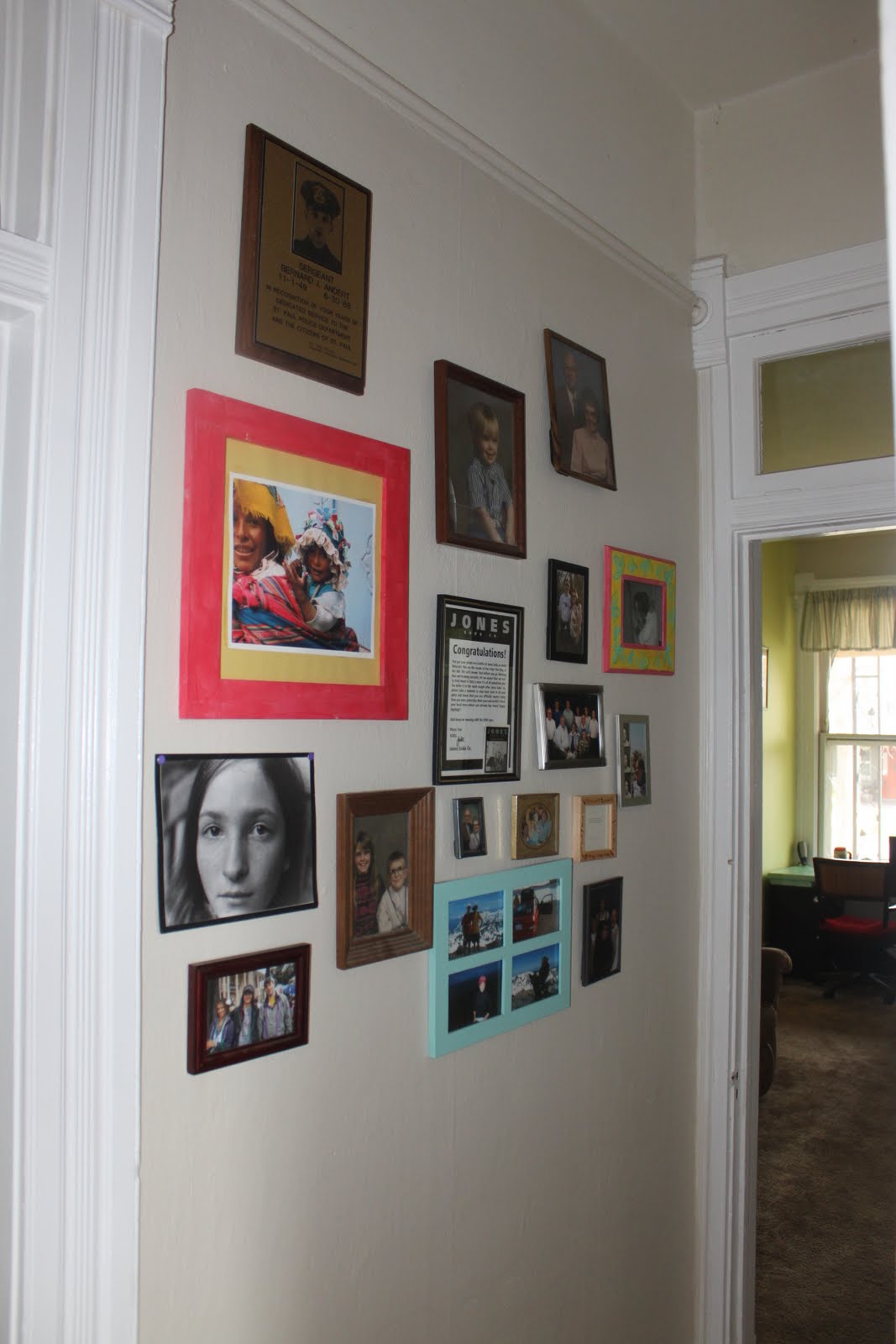
Hallway outside of bathroom and two bedrooms. Family photos :)

Bedroom

'Before' photos of our bedroom. This one looks into the hallway to the other bedroom and bathroom, as well as the dining room and front living room.


The duvet cover was a gift from mom :) We painted the walls 'Banana Split' yellow, paint we had left-over from the farm. The mini-curtain is yellow polka-dots, and the oval flower prints on either side of the window are thrift-store finds.


The door to my closet (which is organized with bins, shelves, and hanging shelves to maximize every square inch of space :) ). Our wedding-collage-window, a vintage hat, and a shadow box where I've stored bits and pieces from our wedding day.


Using the peony stencil that I purchased from esty.com, I stenciled white peonies on one wall. It was far easier than the walls I did at the farm, because I used only one color (and there is only one wall, as opposed to four :)). Vintage jewelry boxes, and my chain with hanging scarves.